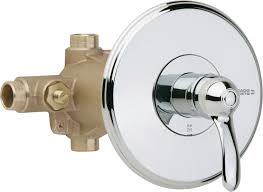
Showers pose a risk of scalding from hot water. In addition to the risk of hot-water scalding, thermal shock from rapid changes in shower water temperature can cause slips and falls.
Plumbing Codes
To protect the user, plumbing codes require that water delivered from showers not exceed 120°F. The plumbing codes no longer consider water heater thermostats, by themselves, a safe means of controlling water temperatures. They require an ASSE 1016 shower valve to control the maximum water temperature and to prevent scalding and thermal shock.
ASSE 1016 Shower Vavles
ASSE 1016 contains requirements for three different types of shower valves.
- Type P: Pressure compensating. This is the most common type of shower valve.
- Type T: Temperature compensating
- Type P/T: Pressure and temperature compensating
Design engineers must decide which type of ASSE 1016 shower valve to specify. First, for individual showers and tub/showers, a Type P pressure-compensating valve prevents thermal shock. Unless thermal shock protection is provided by another device, such as an ASSE 1066 pressure-compensating device, the plumbing code requires an ASSE 1016 Type P or Type P/T shower valve.
Second, the question becomes, is the additional thermostatic protection provided by a Type P/T shower valve needed? This often depends on the hot water system and the expected temperature variation at the shower fixture. Some hot water systems have large temperature variations, for example, residential storage-type water heaters with no recirculation. Due to the phenomenon of “thermal stacking,” hot water temperatures in these systems can easily vary by as much as 10 – 15 degrees F. Another consideration is whether the facility is at a higher risk of scalding, such as hospitals, nursing homes, and assisted living centers. In these instances, a Type P/T shower valve is a good idea.
Design Options
By contrast, some commercial hot water systems with master mixing valves, continuous recirculation, and/or precise controls may have nearly constant hot water temperatures at the shower fixtures. For these systems, a Type P shower valve may be sufficient to limit the shower temperature to 120°F.
Here is a conservative approach: if system temperatures are unstable or unknown, install a thermostatic device (ASSE 1017 master mixing valve in conjunction with ASSE 1016 Type P shower valves, or ASSE Type P/T shower valves, etc.) at some point between the water-heating source and the delivery point. Although this is not a code requirement, maintaining a maximum temperature of 120°F is. A thermostatic device will greatly reduce temperature swings in the hot water system and protect the end-user in the event of a water heater thermostat failure. Design engineers should evaluate the hot water system and make an informed decision about scald protection. Specifying what “everyone else does” or “what meets the code” may not provide the required level of safety needed to prevent scalding.
Installation Requirements
Given the allowable temperature variation in an ASSE 1016 shower valve, at what discharge temperature should the installer set the shower valve to ensure a maximum water temperature of 120°F? Outlet temperatures for ASSE 1016 valves can vary by +/- 3.6 degrees when tested at 45 psi. At higher operating pressures, the temperature swing could exceed ±3.6°F. Therefore, I recommend setting the high-limit stops on shower valves to provide a discharge temperature of 110 degrees F. A shower valve adjusted to provide a 110 degrees F discharge may vary from 105 to 115 degrees F. This temperature range provides a comfortable shower without the risk of scalding from hot water.
Options: integral check stops: Always specify shower valves with integral check stops to prevent the hot water from crossing over into the cold water piping.
The plumbing specifications should require high-limit temperature stops in the shower valves to be set at the time of installation. The design engineer should also check the hot water temperatures at the shower discharge during site inspections prior to project completion.